

Posts Filtered by Month - July 2025 |
Show Recent Posts
July 25, 2025
New to Hiking?
by Paula Uhrin
New to Hiking?
by Paula Uhrin
The club has noticed an uptick in new members and that’s fabulous! But I know that embarking on a hiking journey doesn’t come without worries.
It’s hard to know what’s needed. How much food, water, other supplies? So many variables ... but there are many resources available!
The best thing I can tell you is to not overdo it right away. Start with hikes within your capabilities and you will be surprised how quickly your stamina and endurance increase. While you’re on a hike, take advantage of that time to talk with other hikers about the gear they use. If you’re thinking about a new pair of boots, ask others what boots they like and don’t like and why. What works or doesn’t work for them are both valuable data points. Same goes for backpacks, hydration systems, trail calories, clothing... the list goes on. Hikers are a wellspring of knowledge and often more than happy to talk gear!
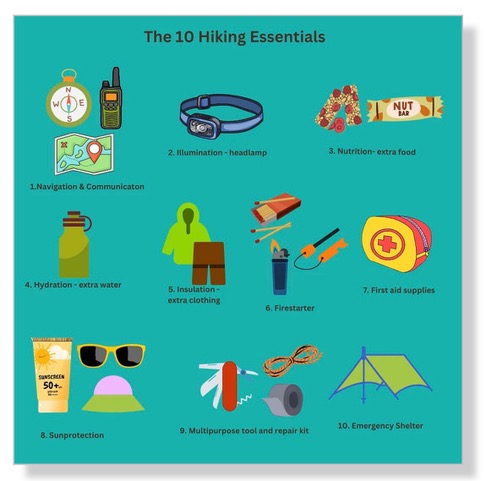
To ensure you are well prepared for a hike, a good place to start is the 10 Essentials of Hiking: Navigation, Illumination, Sun Protection, First Aid, Multi Tool, Fire Starter, Shelter, Nutrition, Hydration, Insulation. Having these essentials with you can help to ensure your trek is enjoyable and safe. I often say that I would rather have something with me and not need it than need something and not have it. It can make the difference between a hike that ends well and one that doesn’t end so well. And sometimes that gear isn’t for you but for someone else on the hike. Ensuring that everyone arrives back at the trailhead is the end goal.
While there is a lot that goes into a trek, hiking really is just about putting one foot in front of the other while enjoying the outdoors. The more you do it, the more you will know what works best for you in a given situation. And then go ahead and share your learnings with others who may be just getting started. The hiking community is comprised of like minded people who are very likely to share their last bit of food or water to help everyone have a great trek.
And don’t forget to Leave No Trace and Carry Out what you Carry In!
And don’t forget to Leave No Trace and Carry Out what you Carry In!
Happy Trails!

July 25, 2025
The AHC and Corridor Monitoring
by Corrie Monitte and Lucy Cantwell
The AHC and Corridor Monitoring
by Corrie Monitte and Lucy Cantwell
I’m a corridor monitor from the Appalachian Trail Conservancy (ATC). I’m here to tell you about the work that your club and 30 other maintaining clubs do to preserve the 2,000-plus-mile footpath known as the AT.
Once a year, the Allentown Hiking Club monitors the boundaries of the AT “corridor” (the sliver of land on either side of AHC's 10.3-mile section of the trail). This is land owned by the National Park Service, and it extends a few hundred feet on either side of the trail.
A critical component of the stewardship of the AT maintaining clubs is corridor monitoring and boundary maintenance—keeping a close eye on the federal estate purchased to protect the Appalachian Trail. Corridor monitoring means walking along and examining the border between this NPS land and the adjacent lands (for example, privately owned lands, state game lands, municipalities) to assure that all boundary markers are in place and no encroachments have occurred. This involves leaving the AT treadway and bushwhacking over rocks and through dense vegetation to locate "monuments," i.e., the markers installed by the original surveyors to establish a line between NPS lands and that of neighboring landowners.
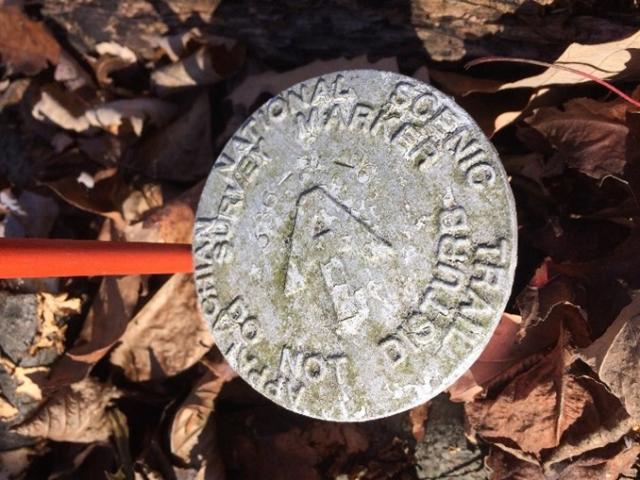
Photo of a typical " monument" (courtesy of Paula Urhin)
The Allentown Hiking Club monitors 35 tracts containing over 600 acres, which has 106 surveyor's monuments and about 15 miles of exterior boundary. This is divided into 7 sections and is monitored by women and men from our club who commit to individual segments of about 4-7 miles each. Encroachments, such as illegal dumping of waste, timber theft, rock piles, discarded machinery, hunting blinds, or evidence of incompatible uses such as ATVs are also documented. These discoveries are subsequently reported to the ATC and corrective action is taken, if needed.
During the monitoring we also post signage along the boundary lines, indicating which areas belong to the NPS, and address minor maintenance issues around the monuments. Volunteer monitors thus become the “eyes and ears” of state and federal landowning agencies. Monitoring helps assure the American public that its investment is being cared for and protected.
The monitoring process is not unlike a scavenger hunt, with instructions and GPS to assist you. If you are a person who loves an adventurous hike, this is it. Some of our long-time monitors, who have been performing this function for upwards of 20 years or more, are no longer able to commit to this duty. So we are looking for some new volunteers to help with this very important task!

Photo courtesy of the Appalachian Trail Conservancy
Just like our little friend above, you can be a part of this action team! According to the ATC Volunteer Leadership Handbook, Corridor Monitors "are responsible for visiting and reporting on the condition of an assigned area of corridor land within a Trail club’s section.... Volunteers interested in monitoring may be quite different from those who like trail work—good monitors often enjoy orienteering, bushwhacking, and traveling in rugged terrain." If you think you might be interested in participating in corridor monitoring, please contact the AT Monitor Coordinators listed under "Contacts" in this newsletter.
We'll teach you how to collect the required information by pairing you with an experienced monitor assessing his/her section of the trail. The commitment on your part, after this simple training, is basically one day a year, scheduled by you at your convenience. Be adventurous! Volunteer and see what it's all about!
~ ~ ~
To learn more about the Appalachian Trail Conservancy, and how it is working to protect and preserve the natural, historical, cultural, and recreational resource known as the AT, please visit the ATC website.
July 25, 2025
AHC Lock 2 Maintenance Trip
AHC Lock 2 Maintenance Trip
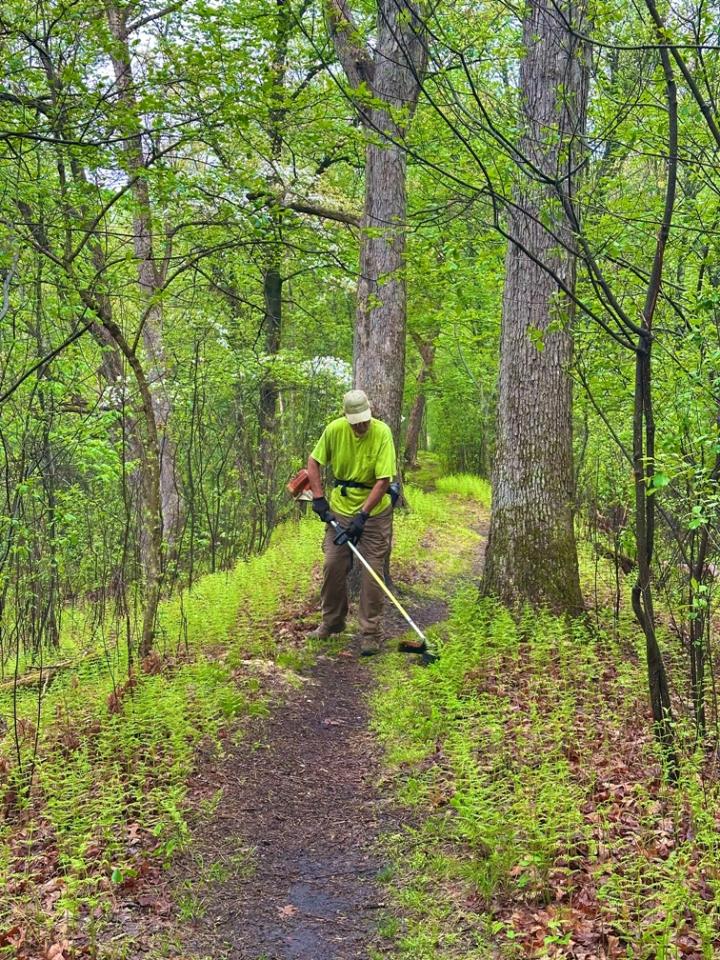
AHC’s spring maintenance trip on May 5th was a successful outing despite being cut short by rain. We worked to maintain the area of high lift Lock 2 on the Lehigh Canal in Lehigh Gorge State Park.
We were able to clear the knotweed to open the access trail to the lock, paint the Lock 2 sign at the access trail, and remove vegetation from the capstones. Sometime over the summer, we plan to install a new post for the access trail sign. Thank you to Ann, Barb, Dave, Paula, Ward, and Wayne. Plan to join us this fall for our next work trip and help preserve this 190 year old high lift lock on the Lehigh Canal.
SEARCH NEWS ITEMS
POSTS BY TYPE
POSTS BY TAG
POSTS BY MONTH